
What Is Fleet Optimization & How To Improve Fleet Performance

The biggest mistake fleet managers make is treating fleet optimization as a project.
Fleet optimization is a business-wide discipline, and the C-suite should include it as a core priority. This shift impacts how leadership understands the challenges and how the business diagnoses — and fixes — the root causes of underperforming KPIs.
In other words, it gives fleet managers the influence to improve performance far beyond their traditional scope.
Let’s get into more details.
What Is Fleet Optimization
Fleet optimization is the continuous, data-driven alignment of assets, people, and processes to achieve maximum operational output at the lowest possible total cost — without compromising safety or compliance.
It’s how you turn each mile, driver hour, and gallon of fuel into higher ROI per truck or trailer, sustainably.
Your business strategy determines what to optimize first.
At a high level, fleet optimization includes three core steps:
- Collecting data at the asset level
- Asking data the right questions
- Fixing what’s broken
Collecting Data at the Asset-Level: Choosing Fleet Optimization Tools
To improve an operation, you need to know how it currently performs.
No matter your strategy, if you don’t have key data streams, you can’t make meaningful improvements. There are many tools online — GPS systems, data platforms, and more — but having clear criteria helps you filter out what doesn’t fit.
Here’s what a carrier prioritizing trailer visibility would look for when evaluating tools:
1. Asset-level, real-time visibility
Know exactly what every trailer is doing so you can measure and improve performance.
SkyBitz capability: SmartTrailer sensors, SkyCamera, continuous location & status data.
2. Idle asset detection
Catch underutilized trailers early and redeploy before they waste weeks in customer yards.
SkyBitz capability: Idle Days identification, automated alerts.
3. Clean integration with your systems
Data should flow into dispatch, billing, maintenance, and TMS systems without friction.
SkyBitz capability: InSight platform, open API, major TMS integrations.
4. Rugged, reliable hardware
Trackers must withstand heat, cold, vibration, weather, and yard abuse to maintain uninterrupted visibility.
SkyBitz capability: IP67-rated, LTE, heavy-duty commercial hardware.
5. Multi-sensor trailer intelligence
Know what’s happening inside the trailer: load, cube efficiency, safety, and conditions.
SkyBitz capability: Cargo sensors, door sensors, volumetrics, tire/temperature monitoring.
6. Frontline usability
Drivers, dispatchers, and yard teams must be able to use the system without IT-level training.
SkyBitz capability: Simple InSight UI + mobile tools.

The questions:
1. Does the system give you uninterrupted, real-time visibility into every asset?
Whether you need high-level insights or deep-dive analysis, you must track data asset by asset. You need continuous visibility into location, movement, door activity, load status, and dwell time per individual trailer.
Even for fleet-wide averages, individual asset data is essential.
2. Does the system detect idle assets quickly?
Idle-time detection helps you:
- Identify underutilized trailers early
- Redeploy assets before they age out in customer yards
- Increase turns per trailer
You want to redeploy your assets before they gather 300 days of dust.
3. Can the tool integrate with your operational systems?
Optimization shouldn’t introduce complexity. Data must flow cleanly into billing, maintenance, dispatch, and TMS systems — otherwise it becomes another silo.
If you need multiple logins to answer a simple question, that’s prohibitive friction.
4. Is the hardware built for real-world fleet conditions?
If a device fails in the heat or cold, your visibility fails with it. Rugged hardware is non-negotiable — especially on unpowered trailers.
5. Does the system support multi-sensor trailer intelligence?
Modern optimization requires more than GPS. You need insight into:
- Is it loaded?
- How full?
- Is the cargo shifting?
- Is the door open?
- Temperature or tire status?
Without this, you cannot optimize turns, cube efficiency, or safety.
6. Can frontline employees actually use it?
If the tool requires IT training, it will not survive deployment. Drivers, yard teams, dispatchers, and installers must be able to:
- access data quickly
- understand alerts instantly
- use mobile tools without friction
Long training reduces retention — and reduces time assets spend moving.
Asking Data the Right Questions: Your Fleet Optimization Model
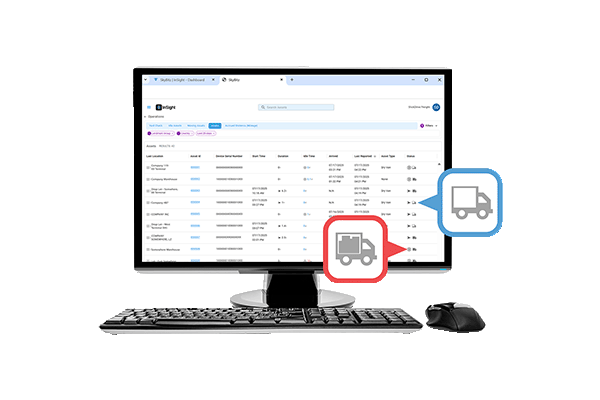
Once you have asset-level visibility, the next step is asking the questions that actually matter to your business.
Before digging into data, clarify your strategy so insights align with high-level goals. KPIs should tie directly to business-wide objectives.
Assuming your data is accurate, look for contradictions between performance and strategy. For example, if you need to increase trailer turns, your questions should highlight what slows movement:
- Which locations generate the longest dwell time?
- Which routes consistently underperform?
- Are lagging assets impacted by driver habits, customers, or scheduling?
You’re identifying recurring constraints that drive cost and reduce velocity — including idle time or incorrect fleet sizing.
Fixing What’s Broken: Behavioral & Operational Changes
The final step — and the step where most optimization efforts fail — is execution. This requires treating optimization as a cross-business discipline.
This reframes challenges and uncovers friction points outside your control:
Maybe warehouse teams load late.
Maybe sales overpromises delivery windows.
Maybe a customer traps your trailers in their yard.
Maybe dispatch relies on habits instead of data.
You can’t fix what you don’t fully understand. Hands-on investigation and cross-department collaboration are essential — which requires executive buy-in.